The Utopia Care barber razor is a folding razor that takes a replaceable blade, and it ships with a hundred of them. That makes it a shavette rather than a forged straight razor: the handle and the holder are reusable, and the cutting edge is disposable.
It suits you if you want blade-first lineups and edging without buying a forged razor, a strop and a hone. It is the wrong buy if you want one blade you sharpen and keep, or if you would rather not handle a bare edge at all.
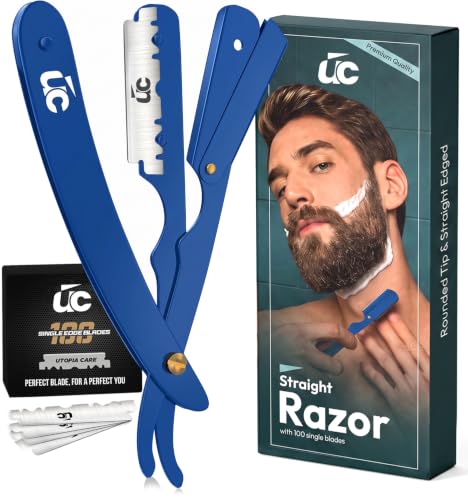
What you get
The listing describes a professional barber straight edge razor in blue with a 100-pack of blades. The product photographs show a folding holder of the barber-razor type, and the pack is printed with “with 100 single blades” and “Rounded Tip & Straight Edge”.
Those are single-edge blades rather than the double-edge blades a safety razor takes. When you buy replacements, match the format the razor ships with, and check the holder against the listing before you order a different blade type.
It is a shavette, not a straight razor
A traditional straight razor carries a single permanent blade of steel. You sharpen it on a stone, realign the edge on a strop, and the same blade keeps serving. A razor that takes a changeable blade is a shavette, and its cutting edge is thrown away instead of maintained.
That is not a cut-down version of the real thing. For hygiene reasons, some places require barbers who shave clients with a straight razor to use a version that takes a disposable or changeable blade, which is what a shavette is. If you want the tool those rules push barbers toward, this is the right category.
What you give up is the single edge you would maintain yourself. What you gain is a fresh one without honing or stropping.
Handling a bare blade
This is not a razor with the edge covered. The blade sits exposed in the holder between two arms, so the handling is closer to a straight razor than to a cartridge razor: the angle and the pressure are yours to control.
Before the first blade goes in, confirm how the holder on your unit opens and locks. Check the instructions if any come with the razor, and if none do, get them from the listing or the manufacturer before you load a blade. Do not assume it matches the last barber razor you used, because the release varies between designs.
Whichever holder you have, the working rules are the same: change blades flat on a surface rather than over the sink, hold a blade by its ends and keep your fingers behind the cutting edge, and check that it sits evenly in the holder before you fold the razor shut.
Spent blades go into a small rigid container kept away from the sink, so nothing sharp ends up loose in a bin liner. If you have not shaved with a razor you hold at an angle before, the technique is the harder part, not the tool: the guide to how to use a straight razor covers grip, angle and the order to shave in.
Who it suits
- You already shave with a safety razor and want to try edging a beard, lining up a cheek or cleaning up the neck.
- You cut hair or shave other people at home and want to change the blade between them.
- You want to learn straight-razor angles without committing to honing and stropping.
Who should skip it
- You want one blade you sharpen and keep. That is a forged razor, and this is not one.
- You want the blade covered while you learn. A safety razor puts a guard between the edge and your skin; this one does not.
- You would rather not handle a bare edge every time a blade dulls.
What it costs to run
The pack is what makes the arithmetic simple: a hundred blades, and no strop, hone or honing paste to buy, because there is no edge to maintain. Blade life depends on your hair and your technique, so treat the pack as a supply rather than a schedule. Even at one blade per shave it covers a hundred shaves.
The holder is the part you keep and the blade is the part you replace, so ownership is a pack of blades rather than a sharpening routine. If you would rather judge when an edge is finished than replace on a hunch, the guidance on how often safety razor blades should be replaced covers the signs worth watching.
How it compares with a safety razor
For most people shaving their own face every morning, a safety razor is the easier tool. Its head holds the blade at a fixed angle relative to the razor and puts a guard between the edge and your skin, so the guard sits where the edge would otherwise bite and there is less to manage yourself. You still set the working angle against your skin, and control pressure and direction, just as you do with the barber razor.
The barber razor earns its place on detail work: a straight edge along a beard line, the end of a sideburn, the back of the neck. If that is the job, this is the inexpensive way to do it. If you want one razor for everything, a safety razor is the simpler choice, and the guides to choosing one and to safety razor kits cover the current options.
Care and storage
Rinse the holder under warm water after each shave, shake it out, and leave it open to air-dry rather than folding it away wet.
If you keep a blade loaded between shaves, leave the holder open until it is dry and keep the razor out of a damp tray. Take the blade out before the razor sits unused for weeks, and store it with the holder closed.
Before you buy
Two things are worth checking before you order: the variant, which here is the blue razor with the hundred-blade pack, and the offer details on the card above, which are refreshed periodically rather than in real time.
If you want a low-cost way to try blade-first shaving with a disposable edge, this is a sensible starting point, and the pack means you will not be rationing blades. If you want one edge to sharpen and keep, this is not it: that is a forged straight razor. If you want the edge covered while you learn, a safety razor is the better answer.


Leave a Reply