A safety razor – also called a double-edge or DE razor – holds one thin, inexpensive blade instead of a multi-blade cartridge. For many shavers that means less pulling and irritation, refills that cost pennies, and far less plastic waste. The trade-off is that a safety razor doesn’t pivot for you: it rewards a light, controlled touch. Get the technique right and it’s a smoother, cheaper, longer-lasting shave. Here’s how to choose one, and five worth buying.
What is a safety razor?
A safety razor is a metal handle and head that clamps a single double-edge blade, with a guard bar (the “safety bar”) sitting between the blade edge and your skin. That bar limits how deeply the blade can cut, which is what makes it far safer than a bare straight razor. You control the angle; the razor doesn’t flex or pivot. Almost every modern safety razor takes the same standard double-edge blades, sold in packs of 5 to 100.
What to look for
- Blade system. Every razor here takes standard double-edge blades, so refills stay cheap and widely available. Avoid anything with proprietary blades.
- Comb type. A closed comb (straight safety bar) is the forgiving everyday choice and the right default for most people. Open combs are more aggressive and better suited to longer growth.
- How it loads. Two-piece razors have fewer loose parts; three-piece razors are the simplest and easiest to clean; twist-to-open (butterfly) razors are the fastest to change a blade in.
- Weight and balance. A slightly heavy head does more of the work for you. Around 70-80 g is a comfortable middle ground.
- Handle length. Standard handles run roughly 90-100 mm. A longer handle can suit larger hands or a lighter grip.
- Build. Chrome plating over brass or zinc alloy is standard; brass cores tend to last longest.
5 safety razors worth buying
Merkur 34C HD – the classic all-rounder
The 34C is the razor many people learn on and never leave. It’s a two-piece design with a closed comb and a short, grippy handle, made in Solingen, Germany. The generous 78 g weight comes mostly from a brass handle, so the head does the cutting without pressure. Mild enough for daily use, effective enough to feel like a real upgrade over cartridges.

Edwin Jagger DE89 – the mild daily razor
The DE89 is a three-piece razor with a hand-polished chrome finish and a famously gentle, closed-comb head – a good pick if your skin is easily irritated or you shave every day. At 68 g and 93 mm it feels light and precise in the hand. Being three-piece, it comes apart completely for easy cleaning.

Parker 96R – fastest blade changes
If you’d rather not line up three pieces when changing a blade, the 96R uses twist-to-open butterfly doors: a quarter turn and the head opens. Note that butterfly opening is a convenience, not an adjustment – the shave is fixed. It has a genuine brass frame, a longer 101.6 mm handle and a graphite-gray and chrome finish. A practical choice for anyone who wants quick, fuss-free blade swaps.

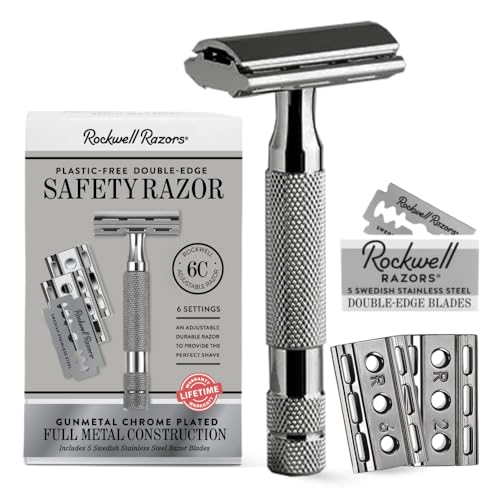
Rockwell 6C – the adjustable
The 6C is the pick if you’re not sure how aggressive a razor you want. It’s a three-piece razor supplied with three reversible base plates, giving six settings from very mild to fairly assertive; you change plates rather than turning a dial. That adjustability makes it a forgiving first razor and a useful one to grow into.
King C. Gillette – the easy budget start
A closed-comb, chrome-handled double-edge razor that’s sold almost everywhere and comes with five platinum-coated blades to get you started – so there’s nothing else to buy on day one. It’s heavier than it looks and mild enough for beginners. The obvious first safety razor if you want to try the format with minimal research and cost.

How to shave with a safety razor without cutting yourself
- Soften first. Shave after a warm shower or with warm water, so the hair and skin are pliable.
- Lather properly. A slick, cushioned lather does more for a comfortable shave than any gadget.
- Use no pressure. Let the weight of the head do the work; pressing down is what causes nicks and razor burn.
- Find the angle. Start with the top cap flat against your skin and slowly tilt the handle down until the blade just starts to cut – roughly 30 degrees.
- Short strokes. Work in gentle, overlapping passes; don’t drag the razor repeatedly over the same spot.
- Two passes at most. One pass with the grain is plenty while you’re learning; add an across-the-grain pass later if you want closer.
- Change blades before they pull. Typically every 3-7 shaves; a tugging blade causes more irritation than a sharp one.
Blade choice matters as much as the razor. Our roundup of safety razor blades and our guide to blades for sensitive skin cover the refills worth buying.
Are safety razors cheaper and greener?
Usually, yes on both counts. Standard double-edge blades cost a few cents each, against several dollars for a multi-blade cartridge, and they use a fraction of the plastic. A single metal razor body can last years – often decades – if you look after it, so the main ongoing cost is a handful of blades.
FAQ
Are safety razors better for sensitive skin? Often, because a single blade and a light touch remove less skin than a tugging multi-blade cartridge. But technique matters at least as much as the razor: no pressure and a good lather are what keep irritation down.
Do all safety razors use the same blades? Nearly all modern safety razors take standard double-edge blades. Check for anything described as proprietary before you buy.
How long does a double-edge blade last? Most people get three to seven shaves per blade. Change it as soon as it starts tugging rather than counting days.
Can beginners use a safety razor? Yes. A mild closed-comb razor like the Edwin Jagger DE89 or King C. Gillette is a sensible first pick; the learning curve is a few shaves, not weeks.
Key takeaways
- A safety razor uses one cheap double-edge blade; the guard bar makes it far safer than a straight razor.
- For most people a mild, closed-comb, two- or three-piece razor in the 70-80 g range is the sweet spot.
- Twist-to-open razors change blades fastest; adjustable razors (like the Rockwell 6C) let you tune the shave.
- Technique – no pressure, a good angle, a sharp blade – matters more than the razor you choose.


Leave a Reply