Most facial hair does not need scissors. If you want length off a beard or a mustache, a trimmer with the right guard takes it off faster and more evenly. Small facial hair scissors earn their place in the details: the hair just inside a nostril, the tuft at the top of an ear, the strays between and above your eyebrows, and the mustache ends you want square instead of rounded.
This page compares three small scissors you can buy today. One is a two-piece set with a curved and a rounded scissor for the least money. One is a single curved scissor with large finger loops from an established grooming-tools brand. One is a dedicated nostril scissor made in Japan. Skip all three if you are cutting the hair on your head, if you want to shorten a full beard, or if you would rather let an electric trimmer do the whole job.
The three picks, at a glance
One row per pick. The cards further down carry the current price and availability; the comparison here is about what changes between these scissors and what you trade away.
| Pick | What decides it, and what you give up |
|---|---|
| Both tips | Both tip shapes for the least money. Cheapest build here, and two small tools to keep track of. |
| One scissor with loops | A curved rounded tip and large loops. One shape only, and about twice the price of the set. |
| Nostril tip | A tip shaped to work just inside the nostril. Single purpose, and the most expensive of the three. |
What actually changes between these scissors
Four things decide whether a small scissor is comfortable to use, and none of them is the brand name on the handle.
- The tip. A rounded tip does not present a sharp corner to your skin the way a pointed haircutting shear does. For nostrils, ears and brows that is the difference that matters most, and all three picks here have one.
- The curve. A curved blade lets you come at the inside of a nostril or an ear from the outside, with your hand out of your own line of sight. A straight blade makes you angle your wrist instead, which is the part people find awkward.
- The length. All three are short, which is what makes them usable this close to your face. The tool has to sit between your eye and the mirror at close range, so a long shear is the wrong shape for this work even though it cuts better.
- The loops. Larger finger loops give you somewhere to hold the scissor other than its very tips. That is the difference between a tool you use for two snips and one you use for a whole mustache without your hand cramping.
Pick 1: the two-piece set, for both tip shapes on a budget
Amazon currently lists this set as TwinPrecision Eyebrow Scissors, and the name undersells it. The title says ‘For Women’, though a small curved and rounded scissor is the same tool whoever is holding it. You get two small stainless scissors, one with a curved blade and one with a rounded tip, sold by Utopia Brands.

Two tip shapes in one purchase, which is the least expensive way to own both a curved and a rounded scissor. If you have never bought a facial hair scissor and you are not sure whether a curve actually helps you, this is the low-risk way to find out: use the curved one around the nostrils and ears, and the rounded one across the brow and along the mustache ends.
What you give up is build quality. These are the least expensive scissors on the page, and short blades mean a full mustache takes several passes rather than one clean line. For occasional strays that is the right trade. If you trim every few days and want better build for the money, the next pick is the one.
Pick 2: the Tweezerman scissor, one pair worth keeping
Tweezerman’s facial hair scissor has a curved blade with a rounded precision tip that the manufacturer describes as curving away from the skin, and large finger loops. It is stainless steel and sold as a single scissor.

One shape, and the one to buy if you want to own a single scissor rather than a set. The curve is what you are paying for here: it keeps the tip angled into the space you are trimming while your hand stays where you can see it, which is the part a straight blade makes you improvise. The difference shows up most along a mustache edge or at the outer corner of a brow, where the curve does the angling for you.
What you give up is money and flexibility. It costs roughly twice the two-piece set and gives you one blade shape, so if you want both a curve and a blunt tip, you buy twice. At this price it is still a mass-market grooming tool rather than a hand-finished shear, and should be judged as one.
Pick 3: the Seki Edge nostril scissor, for one job only
The Seki Edge SS-908 is a single stainless scissor with a smooth rounded tip, made in Seki, Japan, with hand-sharpened blades. It is sold as one scissor, not a set.
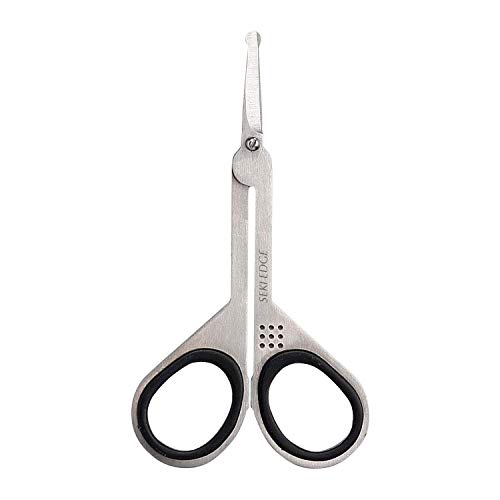
This is the pick for the reader whose problem is specifically nostril hair. The tip is rounded and small enough to go slightly inside the nostril, which is exactly where a general facial scissor starts to feel like the wrong shape. If nose hair is the whole reason you are shopping, buy this one and skip the other two.
What you give up is everything else. It is the most expensive of the three, it has no brow or mustache shape, and tidying a mustache still needs a second tool. Buy it as a specialist, not as your only scissor.
Which pick for which job
- Nostrils. The Seki Edge, or the curved scissor from the set. Cut only the hair you can see, in small amounts. How to trim nose hair without causing pain covers the technique in detail.
- Ears. The curved scissor, again working only on what is visible at the edge of the ear. Getting a mirror angle you can actually see beats any difference between these three.
- Mustache. The rounded tip from the set, or the Tweezerman, worked along the line you want rather than around it. A comb holds the hair away from the skin while you cut, and choosing the right comb matters more here than the scissor does.
- Brows. The rounded tip. Comb the brow up and take only the tips that sit outside the line you want; this is the one job where taking too much is obvious immediately.
- Stray cheek and neck hairs. Any of the three. This is what a small scissor is for between proper trims.
What these scissors will not do
They will not shorten a beard. Taking length off evenly across a whole beard is a trimmer’s job, and if what you want is a pair of longer scissors for beard and mustache lines, our guide to beard scissors compares those by hand, size and price instead.
They are also not haircutting shears. A short facial scissor is the wrong tool for the hair on your head, and the barber scissors for cutting hair are a different shape, weight and price for a reason.
And they will not replace a trimmer for bulk. If your routine is one pass over the whole face with a guard, keep doing that and buy a small scissor only for the places a guard cannot reach.
Using them safely
- Cut small amounts and check as you go; you can always take more off, and you cannot put it back.
- Trim nose and ear hair rather than pulling it out with tweezers. Tweezerman’s own directions say to trim it rather than pull it, and that holds whatever brand you buy.
- Work in good light with a mirror you can get close to. A short scissor exists because this job happens inches from your eye.
- Keep the blades closed when you are not cutting, and keep your fingers behind the pivot rather than near the tip.
Care: two minutes that keep them cutting
Wipe the blades after each use. Hair and skin oil sit on the edge and dull the cut long before the steel wears out. A drop of light oil on the pivot every few months keeps the action smooth. Store them dry and closed, and not loose at the bottom of a washbag where the tips carry the weight of everything above them.
Before you buy
If you want to spend as little as possible and get both tip shapes, take the two-piece set. If you want one scissor you will still be using next year, take the Tweezerman. If nose hair is the entire problem, take the Seki Edge and ignore the other two.
If you are still deciding whether scissors are your tool at all, work that out before you spend: which grooming tool suits which shaping job compares scissors against trimmers and clippers for the same jobs.


Leave a Reply