The Honest Amish beard balm does two jobs at once: it conditions a dry beard and it tames it. This page covers what the balm actually is, who it suits, what it will not do, and what to buy instead if it is not the right fit for you.
It suits you if your beard feels dry and you want one tin that softens it and holds stray hairs in place, especially if you prefer a short ingredient list to a styling wax. Skip it if you want strong hold or sculpting. Skip it too if your beard is already soft and only needs moisture, where a lighter oil is the better buy. And it is not a replacement for washing or conditioning; a balm sits on top of them.
The short answer
- For one natural tin that conditions and holds: the Honest Amish Beard Balm for Men, 2 oz – the product this review covers.
- For the same job without fragrance: the Striking Viking Beard Balm, sold unscented in a 2 oz size.
- For a cheaper scented balm with more weight: the Viking Revolution Sandalwood Beard Balm, 2 oz.
What the Honest Amish balm actually is
Honest Amish sells this as a natural leave-in beard conditioner, and the listing describes it as a blend of shea butter, coconut oil and argan oil that softens and conditions for daily beard styling. In practice it is a balm: a firm butter you warm between your palms rather than a liquid oil or a watery cream. It comes in a 2 oz tin, which is a normal size for a balm and lasts a while, because you use only a pea-sized amount at a time.
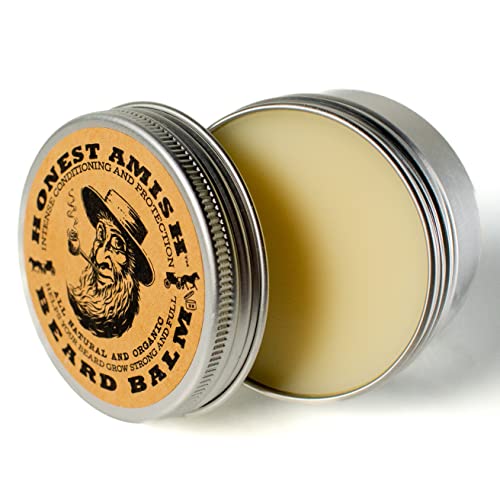
The reason to choose it over an oil is that combination. The butters condition the hair, and the balm’s slight waxiness adds enough hold to keep stray hairs down without the beard feeling like it has product in it. If you want conditioning alone, an oil does that more lightly; if you want the two together in one step, this is where a balm earns its place.
How to use it
- Start with a clean, slightly damp beard. A balm spreads more evenly on damp hair than on a dry one.
- Take a pea-sized amount and warm it between your palms until it softens.
- Work it from the roots to the ends, then down into the skin underneath to moisturize it too.
- Comb it through to spread it evenly and line the hairs up; a beard comb does this better than your fingers.
- Use it once a day as a finisher, after washing and after a conditioner if you use one, rather than instead of them.
What it does well, and what it does not
Good at
- Conditioning dry hair without a separate product.
- Light hold that keeps flyaways and stray hairs in place.
- A short, natural ingredient list, if that matters to you.
- A small amount goes a long way, so a tin lasts a long time.
Not the tool for
- Strong-hold styling. A beard that needs sculpting wants a wax or a pomade, not a balm.
- Adding moisture with no weight at all. That is what beard oil does rather than a balm.
- Growing new hair. No balm does that; whether a patch fills in is largely down to genetics.
- Repairing split or breaking ends. Only a trim fixes those; a balm smooths the feeling, not the cause.
Balm, oil or conditioner: which one you actually need
These three get used as if they were interchangeable, but they do different jobs. An oil is the lightest and adds moisture and shine. A balm is heavier and adds the light hold an oil does not. A conditioner is what you reach for after washing to put softness back into the hair. Many beards end up using two of the three.
The Honest Amish balm sits deliberately in the middle – condition and hold – which is why it pairs with the brand’s own oils rather than replacing them. If your beard feels rough even after washing, start with beard conditioner and add a balm afterwards; if it only needs moisture and shine, an oil on its own is enough. For the brand’s liquids specifically, here is how the Honest Amish oils compare.
Where it fits in a routine
The order that works for most beards is short: wash less often than you think you should, condition after washing if the beard is dry, then finish with a small amount of oil or balm and comb it through. A balm is the finishing step, so it goes last. If you are still choosing that first step, our guide to a beard wash covers how often to use it and what to look for.
If the Honest Amish balm is not for you
The usual reasons to look elsewhere are fragrance or price. If you want a balm with no added scent, the Striking Viking balm is sold unscented, in a 2 oz size, built on argan and jojoba oils; the listing describes it as a moisturizer and styling balm that softens coarse facial hair. It does the same condition-and-hold job without making you commit to a scent.

If scent is fine and you want a little more butter-like weight for less money, the Viking Revolution Sandalwood balm is a 2 oz beard butter built on argan oil and sold for shaping and conditioning. It is a plainer product than the Honest Amish balm – less of a natural-ingredient story, more of a workhorse – and it is a fair pick if you go through balm quickly.

If you would rather see a wider field before deciding, our beard balm roundup compares six balms by hold, scent and softness.
The bottom line
The Honest Amish beard balm is a sensible buy if you want one natural tin that conditions a dry beard and holds it in place, and if you like the idea of an ingredient list you can read. It is not a styling wax and it will not grow or repair hair, so buy it for comfort and light control rather than a transformation. If you are sensitive to fragrance, start with the unscented option instead.


Leave a Reply