A nose hair trimmer is one of the few grooming tools where spending less is usually the right call. There is no length setting to get wrong, no blade gap to adjust and no motor to size for thick hair: you put the head at the edge of the nostril, a blade turns behind a slotted guard, and the hair that pokes through the slots comes off.
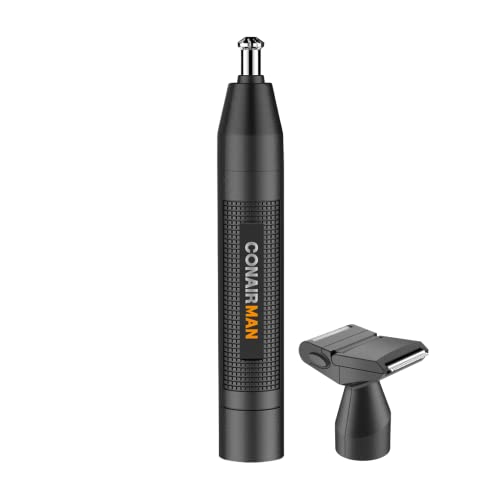
The ConairMan Nose Hair Trimmer for Men does that at the cheap end of the market: a cordless handle with the maker’s 360 bevel blade, a detail head and a shaver head. It suits you if the problem is visible hair at the nostril or ear opening and you want it dealt with without buying a system. Skip it if you want one device that also handles a beard, a neckline and your brows. This is a single-purpose tool, and it does not pretend otherwise.
What you get
The set covers nose, ear and brow work. The detail head is the narrow cylinder that goes at the nostril opening and the ear opening. The shaver head is for flat skin, which in practice means the back of the neck or the space between the brows rather than anything inside the nose.
It runs on a battery rather than a rechargeable cell, so the running cost is a replacement every so often. The trade is a trimmer small and light enough to live in a wash bag without a charger following it around.
How the 360 bevel blade works
The head is a slotted cylinder with a blade turning behind it. Hair that enters a slot is cut against the edge and stays inside the head until you tip it out. Our reading of the design is that “360” means the cutting window runs the whole way round the cylinder, and “bevel” describes angled slot edges, which is what lets hair slide in rather than being pressed flat against the skin.
Conair’s claim for this head is “no pull, no snag”. The mechanism behind that claim is the ordinary one for this class of trimmer: because the cutting window wraps the head, you do not have to find one correct angle. You rotate the head against the opening and the slots do the work. What it does not promise is speed. A bevel head cuts what enters the slots, so expect a few passes in a couple of directions, and do not press — pressure only pushes the guard into skin.
Nose, ears and eyebrows are three different jobs
The nose is the easy one, and the only part most people need: the head goes to the edge of the nostril, where the hair is visible, and stops there. There is no benefit to working it further in. If you have never done it before, the technique matters more than the tool, and trimming in short passes rather than one long push is most of it. How to trim nose hair without causing pain walks through the method.
The ear opening works the same way, with the same limit: the head goes to the edge of the canal rather than into it. The ear does not need to be hairless, only tidy.
Eyebrows are the job this tool is worst at. A rotating cylinder removes hair in a band, and a brow needs a line and a stopping point; a cylinder does not give you the straight edge a brow line needs. If brows are the reason you are shopping, a small pair of facial hair scissors gives you an edge and a guide finger, which is the thing a cylinder cannot give you. Trimming the strays between the brows with the shaver head is reasonable; drawing the brow shape is not.
The battery is the one thing to plan for
A battery tool is only as good as the spare in the drawer. Keep one where you keep the trimmer: the failure here is not a bad shave, it is discovering a flat trimmer mid-routine with nothing to put in it. That is the entire maintenance burden, and it is part of why the price sits where it does.
Cleaning decides how long it lasts
Clippings pack into the head, and a clogged head cuts worse than a sharp one. Brush the hair out over the bin every few uses, and put the tool away dry. That is the whole routine, and it is the part that keeps the cut working. The wider method for this class of tool, including what not to do to the cutting edges, is in how to clean a nose hair trimmer.
What it is not
It is not a beard trimmer: there are no length guards, so there is no way to leave a beard at 4 mm and tidy the edges with the same device. If that is what you actually need, the shortlist is in beard trimmers for every job, and it is a different purchase at a different price.
It is also not the only shape this tool comes in. Rotary heads, wet-and-dry bodies and rechargeable handles are the alternatives at this end of the market, and each solves a different annoyance. If you have not decided which of those matters to you, compare the options before buying rather than after. How to choose a nose and ear hair trimmer sets out the differences that change the experience.
Who should buy it
Buy it if your problem is visible nose and ear hair, you trim at the mirror every week or two, and you want a tool that does that one thing without a charger, an app or a routine. The 360 head means you will not fight the angle, the detail head reaches the openings, and the shaver head earns its place on the neck.
Do not buy it if you want a single device for beard, brows and body, if you would rather charge than buy batteries, or if precision edging is the part you care about. Those are three different products and none of them is this one.
Check the current configuration and availability before you decide. At this end of the market the honest question is not whether a bevel head trims, since it does, but whether the tool will still be in your drawer in a year. A spare battery, a brush-out after each use and a dry head are what decide that.


Leave a Reply