Three different mechanisms are sold under the word “adjustable”, and they do not suit the same person. If you have been told to buy an adjustable safety razor and you are standing in front of a page of them, the useful question is not how many settings the box advertises. It is whether you want to change the gap by turning something or by taking the razor apart, and whether you will ever change it at all.
This is for someone who has settled on a safety razor and is deciding whether to pay extra for adjustment. It assumes you shave your face. If you have not picked a razor at all yet, read how to choose a safety razor first, because that decision comes earlier. If you already own a razor that works and you shave the same amount every day, the honest answer is further down this page: you probably do not need this.
What adjustment actually changes
A safety razor holds one blade at a set angle above a guard. Two measurements describe the result: the gap between the blade edge and the guard, and how far the edge stands proud of the guard. Open that gap and the edge meets more skin and more stubble on each pass. Close it and the razor forgives a heavier hand.
A fixed razor picks one of those settings and stops. Merkur publishes its own geometry, and its fixed straight-bar models — the 34C among them — sit at roughly a 0.5–0.6 mm gap. Its adjustable 500 and 510 models move from about 0.6 mm to 1.6 mm, and the heavier Futur series publishes 0.9 mm to 1.9 mm.
So adjustment buys range, not quality. What you get for the money is the ability to shave your neck and four days of jaw growth with one razor, instead of owning a mild razor and an aggressive one.
Three mechanisms, three trade-offs
| Type | How the setting changes | What it costs you |
|---|---|---|
| Dial | You turn a numbered knob, usually at the bottom of the handle. The Parker Variant has five settings. | More mechanism to rinse, a heavier head, and a higher price than a fixed razor of similar build. |
| Plates | You unscrew the head, flip or swap a base plate, and reassemble. Rockwell’s 6C and 6S use three reversible plates for six settings, R1–R6. | You stop shaving to change it, and a plate off the razor is a part you can lose. |
| Vintage | A numbered dial built into a twist-to-open head. Gillette’s Toggle, Fatboy, Slim and Super Adjustable families used five- and nine-position dials. | You are buying second-hand: condition, alignment and spare parts are all yours to check. |
The first two are what you can buy new. The third is a collecting route as much as a shaving one, and it is worth knowing about mainly so you recognise it when a listing uses the word.
The dial: change the setting without taking the razor apart
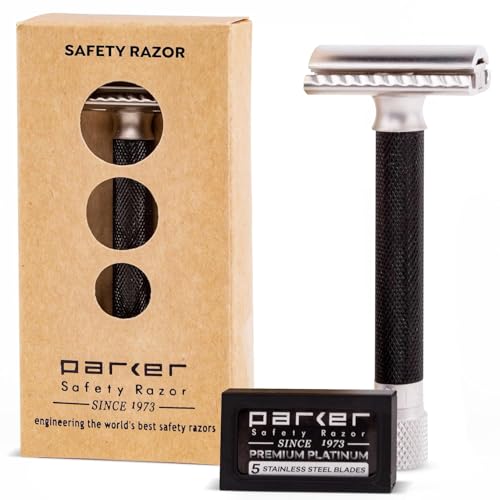
The Parker Variant is the clearest example of the dial route: a closed-comb head with five numbered settings and the adjustment knob at the base of the handle. The head is the heavier part, which is where the mechanism lives.
What the dial buys you is a change between passes. Set it low for the neck, where the hair is thinner and the skin is not, then turn it up for the jaw without putting the razor down, unloading a blade, or hunting for a dropped plate. If your growth is genuinely mixed — a daily neck shave plus a weekly full pass — that is a real convenience rather than a feature on a box.
The costs are physical. The mechanism lives in the head, so the razor carries its weight further forward than a fixed razor does, and there is one more assembly to rinse lather out of. Dial razors also cost more than fixed razors built to a similar standard, which is the reason to be sure you want the mechanism before you pay for it. Merkur’s Futur series is the extreme end of the same idea at 0.9–1.9 mm and about 129 g, which is a great deal of razor to steer around a jaw.
The plates: six settings and a small ritual
Rockwell does the same job with three reversible base plates instead of a dial. Each plate carries two settings, so six in total, and Rockwell labels R1–R3 for sensitive skin and R4–R6 for thick, coarse hair. Changing the shave means unscrewing the head, flipping or swapping the plate, and putting it back together with the blade clamped between them.
That is slower than a dial, and it is precisely why the plate system suits a different person: someone who wants to find a setting, leave it there, and stop thinking about the razor. The plate you like stays on the head for months at a time. The trade is that changing mid-shave is impractical, so the range is something you explore over weeks rather than within one shave.
For what those six settings feel like in use, and whether the stainless 6S is worth the step up, read the Rockwell 6C review. It works through the Gunmetal finish; the razor itself is the same in either colour, so the settings behave the same way. This page is about the mechanism, that one is about the razor.

Choosing the range, not the number
Ignore the largest number on the box and answer two questions: how often do you shave, and how does your skin react to a blade?
| Your situation | What you actually need |
|---|---|
| Daily, reactive skin | The bottom third of the scale, and nothing above it. A fixed mild razor covers this. |
| Every few days | A middle setting you can nudge up on the third day. |
| Coarse, once a week | The top of the range, with a head that does not flex under the growth. |
| Still deciding | Small steps you can compare, which is where plates have the advantage. |
Our reading of that table is blunt: someone who shaves daily with reactive skin will live in the lowest two settings of any adjustable they buy, and a fixed razor at that gap does the same work with less to clean. The person who genuinely uses a range is the one whose growth varies across the week, or across the face.
The trap: most owners settle on one setting
Six settings read like six times the value. In practice a razor settles into the setting that suits your face, and the dial stops moving once that happens. The argument for the third route follows from that: if you have found the setting you like, buy the fixed razor that matches it and spend the difference on blades you actually want. That is a judgment about how people shave rather than a promise about your face, and it is the reason this page names a fixed razor at all.
The Merkur 34C is that decision made concrete — a straight-bar head in the mild 0.5–0.6 mm range on a short, heavy handle, with nothing to adjust and nothing to lose. If you have already worked out that a mild setting is where you live, this gives you the same shave with none of the mechanism.

Adjusting without cutting yourself
Both mechanisms come with one rule that follows from how they are built rather than from opinion.
On a plate razor you cannot change the setting with the blade loaded and the head closed, because the same screw clamps the plate and the blade. Changing it means taking the razor apart, blade out, over a towel rather than over the sink.
On a dial razor the adjustment turns while the blade is clamped, which is convenient and is also where people cut themselves: the natural moment to reach for the dial is mid-shave, with wet hands and your attention on the mirror. Turn it while the razor is parked. Set the gap before the first stroke, and treat a change of setting as the start of a new pass, not something you do while the blade is moving.
The rest is ordinary technique, and it matters more than the setting does: the first month with a safety razor covers angle and pressure step by step.
What adjustment does not fix
A milder setting will not rescue a blade that does not suit you, and it will not correct pressure. If you already have burn or ingrown hairs, the blade and the number of passes are the first things to change: choosing blades that suit your skin is worth an hour before any razor purchase. Adjustment also does nothing for preparation, and nothing for going over the same spot again and again, which is what most irritation actually is.
Before you buy
- How the blade loads. Some heads open by twisting the handle, others come apart into a cap, plate and handle. If you want the razor to open without your fingers near the edge, that is a different mechanism: how a butterfly razor works.
- Whether the scale is stepped or continuous. Five marked positions and a smooth range are different things, and the difference only shows up when you are trying to move by a small amount.
- Weight and balance. Mechanism adds metal. A dial razor in the Futur class is around 129 g, which changes how much control you have on a downward stroke.
- Spares. Plates, caps and springs wear or go missing. A plate system with no replaceable plates is a disposable razor with extra steps.
- Cleaning. Every added joint is somewhere soap can set. More mechanism means more attention: maintaining a safety razor.
- Blades. The razor is the fixed cost and the blade is the running one. Decide the razor around the blade you like, not the other way round.
The short version
- Adjustment buys range. It does not buy a closer or gentler shave by itself.
- A dial changes the gap without disassembly: convenient, heavier, dearer.
- Plates give six settings but require taking the razor apart: cheaper to live with, slower to change.
- Vintage twist-to-open adjustables are a second-hand purchase with second-hand risks.
- If your shaving is the same every day, buy fixed at the gap you like and put the money into blades.
If none of that describes your week, you do not need an adjustable razor, and the better purchase is the fixed one you will stop thinking about.


Leave a Reply