A butterfly safety razor opens by twisting the handle. The two halves of the head swing apart like a book, you drop a double-edge blade over the pins, and you twist it shut. Nothing comes apart in your hand and your fingers never go near the cutting edge.
That is the whole case for it. If you want one blade at a time and no cap and baseplate to line up over a wet sink, a twist-to-open head is the least fiddly way to get there. The cost sits on the other side of the ledger: doors and a centre post give soap somewhere to collect, the head is taller than a flat cap, and the blade gap is fixed. If you want to change how aggressive the razor feels from week to week, this is not the mechanism that does it.
Below is how the head works, what it gives up, how to load a blade without cutting yourself, and four twist-to-open razors that are in regular supply, compared on the things that actually differ between them: the handle, the weight, and what comes in the box.
What “butterfly” and “twist to open” mean
They are two names for one mechanism. Parker, which makes two of the razors below, files them under “butterfly open” and describes the head as twist-to-open. Retailers and shaving forums usually shorten it to TTO. The name changes nothing about the razor.
How the twist does it: the knob turns a threaded post that runs up through the handle, and the two door arms ride on that post, so a single turn opens or closes both doors together. That is why the head is one sealed unit rather than a cap and a baseplate.
The name also gets borrowed. The Butterfly Kiss, sold under a similar name, is an electric body shaver and not a safety razor, and nothing on this page applies to it. A butterfly head is also not a butterfly knife: there is no flick, no latch and no free-swinging blade.
What the mechanism buys you
- Blade changes without disassembly. A three-piece razor means setting a top cap and a baseplate down somewhere while you swap a blade. With doors, there is nothing to set down, which matters most when your hands are wet and slippery.
- Your fingers stay away from the edge. The blade drops onto the pins and the doors close over it. You can seat a new blade without pinching it between thumb and forefinger.
- A swap mid-shave takes seconds. If the first stroke tells you the blade is rough, you can change it without leaving the sink or drying your hands.
- One piece in the bag. There is no baseplate to leave in a hotel bathroom.
- Rinsing is a two-second job. Twist, the head opens, rinse between the doors, twist shut. You get at the trapped lather directly instead of relying on water pressure through a gap.
What it costs you
None of these is a defect. They are the trade you accept for the convenience above, and they matter in proportion to how fussy you are about the shave itself.
- More surfaces to rinse. Doors, hinges and a centre post collect soap film in a way a smooth cap does not. If you rinse only under the tap with the head closed, residue builds up around the mechanism. Opening the head once at the end of the shave is the habit that prevents it.
- You should check the blade is seated evenly. The blade locates on two pins, and it is worth a glance at both edges before you close the doors fully. A blade sitting slightly proud on one side will shave unevenly on that side. It takes a second, and it is the step people skip.
- The head is taller. Domed doors sit further off the face than a flat top cap, so the clearance under your nose is tighter. It is manageable, but it is the one place the mechanism makes you work.
- The blade gap is fixed. Nothing here adjusts. If you want to move between a mild and an aggressive shave with the same razor, that is a plate-swapping or adjustable design, not a twist-to-open head.
- The hinge is a moving part. A mechanism that is rinsed and dried keeps its action; one left with soap in it will stiffen and feel vague. This is the part of a butterfly razor that ages, rather than the head.
How to load a blade in a butterfly razor
- Hold the razor over the sink and twist the knob at the base of the handle in the opening direction until the doors swing apart.
- Rest the head face-down on the counter or in your palm, and drop the blade over the two pins so both cutting edges face outward.
- Look at both edges. The blade should sit flat and even. If one side stands proud, lift it and reseat it before going further.
- Twist the knob the other way until the doors meet the blade and stop. Firm is enough. You are closing doors, not tightening a bolt, and over-tightening gains nothing.
- Rinse the closed head under warm water, open it once, rinse between the doors, and close it again.
Four butterfly razors compared
All four are twist-to-open heads and all four are in regular supply. Handle length, weight and what comes in the box are what separate them.
| Razor | Handle, weight, contents | Buy it if |
|---|---|---|
| Feather Popular | 4.05 in, 1.2 oz (34 g). Plastic handle, metal head. | You want the least expensive way to find out whether you like a butterfly head |
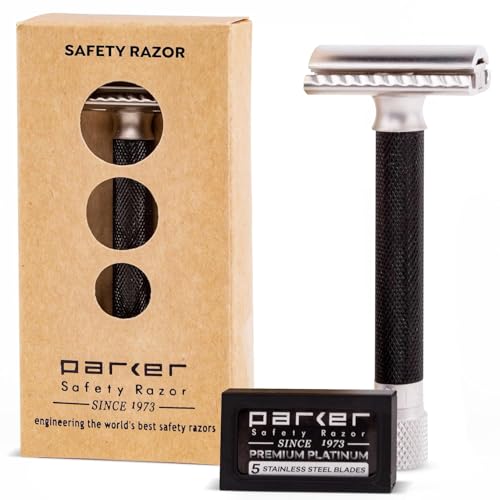
| Parker 96R | 4 in, 2.85 oz. Brass frame, slim textured handle. | You want a brass body and your hands are not large |
| Parker 29L | 4.4 in, 2.9 oz. Brass frame, long textured handle. | You shave your legs, or you just want the longest handle here |
| Amazing kit | Razor, brush, stand, soap bowl, blades. | You would rather order one box than four separate things |
Feather Popular: the cheapest way in
Feather’s model number for this razor is FH-H, and it arrives with two Feather Hi-Stainless blades, which is enough to decide whether the format suits you. It is made in Japan. The handle is plastic with a metal head, 4.05 inches long and about 1.2 oz (34 g).
That weight is the point and the problem. At about 40 percent of the weight of the two brass razors below, it asks less of your wrist, and a lighter razor is easier to keep to the light touch a double-edge blade rewards. What you give up is feel: plastic does not have the cold solidity of brass, and it will not age into anything. As a first butterfly razor, or a second one for travel, it is the low-risk purchase of the four.

Parker 96R: the standard brass body
Parker’s own specification for the 96R is a butterfly open head on a genuine brass frame, graphite-gray and chrome plated, 4 inches long and 2.85 oz. At 4 inches it is a hair shorter than the Feather’s 4.05 in and 0.4 in short of the 29L. At 2.85 oz it is within 0.05 oz of the 29L and more than twice the Feather’s weight, so between these two Parkers it is the handle, not the mass, that decides it. Parker describes the handle as textured with a thinner diameter, which the company pitches at smaller hands.
The brass frame is what you are paying for over the Feather: more mass low in the hand, and a plated metal body instead of a plastic one. The slim diameter cuts both ways. It is comfortable and controlled if your hands are average or small, and it can feel like holding a pencil if they are not.

Parker 29L: the long handle
The 29L is the same butterfly mechanism on a handle 4.4 inches long, 2.9 oz, brass frame with a lavender anodized chrome finish, and five Parker Premium Platinum blades in the box. Parker designed it for women and describes the handle as long, thin and highly textured, which is the combination that survives wet, soapy hands in the shower.
That extra four-tenths of an inch is not a marketing detail if you are shaving your legs: it is the difference between reaching an ankle comfortably and improvising. If you shave your face with it, you get the longest handle here on a fixed-gap butterfly head like the 96R’s. The full review of this one is in our Parker 29L long-handle review.

Amazing Safety Razor Shave Kit: one box, whole setup
This is the only one of the four that is a starting kit rather than a razor: a butterfly open razor, a brush, a stand, a shaving soap bowl and a pack of super stainless blades. The listing gives no weight or handle length for the razor itself, so there are no numbers to compare it on, which tells you what the product is. Buy it because you want the brush, the stand and the bowl in the same order, not because the razor is specified better than the others. It is not.
For someone starting from nothing, that trade is reasonable. A brush does most of the work of turning soap into lather, and a bowl gives you somewhere to build it without chasing it around your palm; bought separately that is three more orders. If you already own a brush, skip this and put the money into the 96R.

If what you want is a three-piece
The honest reason to walk away from this mechanism is control over aggression. A twist-to-open head gives you one fixed gap and nothing on this page changes it. If you want to move between settings as your technique settles, or you want the flatter head and the tighter blade clamping of a three-piece, that is a different purchase and a legitimate one. Our guide to choosing a safety razor and five worth buying covers both designs side by side.
Blades and upkeep
Any standard double-edge blade fits any of these four, so the blade is a separate decision from the head and a larger one. A sampler tells you more in a month than a hundred-pack of one brand, and choosing double-edge blades that suit you explains what actually changes between blades. If your skin reacts easily, razor blades for sensitive skin narrows the field.
Two habits matter more with doors than with a fixed head. Open the razor and dry it after every shave, because the hinge is the part that stiffens once soap dries in it; how to maintain a safety razor so it lasts covers the rest of the routine. And change the blade at the first pull rather than at the first nick, which arrives sooner than most people expect: how many shaves to expect from one blade puts a number on it. If this is your first single-blade razor, the first month with a safety razor covers the angle and the pressure, which is where most of the discomfort comes from.
The short version
- A butterfly, or twist-to-open, razor loads by twisting the handle so the head opens. No parts to remove.
- Choose it for easy blade changes and one-piece convenience. Accept a taller head, a fixed gap and more rinsing around the doors.
- Check the blade is seated evenly before every shave, and rinse the head open at the end of it.
- Cheapest way to try the mechanism: Feather Popular. Standard brass body: Parker 96R. Longest handle: Parker 29L. Whole setup in one order: the Amazing kit.
- If you want to change aggressiveness, buy a plate-swapping or adjustable razor instead. A butterfly head will not do it.


Leave a Reply