Soap and cream do not give you two different shaves so much as two different amounts of work. A good product in either format will do the job; what actually changes is how long you spend building the lather, how far the tub goes, and how forgiving the product is with the water in your bathroom.
This page is for someone choosing between the two before buying, usually after finishing a can of foam and wondering whether the upgrade is worth the extra step. Skip it if you are happy with a gel or foam and have no intention of buying a brush: nothing here replaces that convenience, and the closest thing to it is a cream you can spread with your fingers.
What you are actually choosing between
Neither of these is a can of foam. Soap is a saponified product sold as a firm puck or poured into a tub, and you load a wet brush onto it before building the lather on your face or in a bowl.
Cream starts softer and looser, and it comes in two kinds that get bundled together constantly. A lathering cream still needs a brush but is quicker to bring up than a puck. A brushless cream is spread with your fingers and, as Barrister and Mann put it, should be kept away from a brush altogether, because a brush gets clogged and damaged by it.
That split is the first thing to settle. It decides whether a brush is part of your purchase before you compare anything else.
| Soap | Cream | |
|---|---|---|
| Form | Firm puck | Soft, scoopable |
| Brush | Always | Only if lathering |
| Lather | Built slowly | Builds faster |
| Travel | Bulkier | Easier to pack |
The table is about handling, not quality. Both formats produce lather; the left column simply asks more of you before it does.
The sources disagree, and that is the useful part
Most pages answering this question are shop content, and the argument tends to land on the side of what the shop sells. A soap maker describes soap as building a denser, slicker lather and giving a closer shave. One brand’s own comparison says cream is often more moisturising than soap. Each may be describing the products they actually make.
The most useful line comes from a shop with a clear interest in the other answer. Barrister and Mann sell soap, and they still write that sensitive skin benefits from the right formula rather than the format, because ingredients matter more than the type. Gentleman’s Gazette, an editorial guide rather than a shop, arrives at the same place from the opposite direction: a quality cream and a quality soap produce similar results, and the real differences are the effort involved and the cost per shave.
So treat format promises carefully. “Cream is more moisturising” is a claim about one cream’s formula wearing the name of a whole category.
What will actually decide your shave
Four things, roughly in this order.
- The formula. If your skin stings or breaks out, scent and preservatives are the first suspects, not the word on the tub. Creams commonly carry synthetic fragrance to hold a scent; soaps vary widely in how they handle it. Changing format while keeping the same fragrance usually changes nothing.
- Your water. Hard water is the strongest argument for cream in this whole comparison. Minerals interfere with the fats that hold a soap lather together, and the usual workarounds are distilled water, a better brush, or a soap formulated to cope. A cream’s emulsified structure starts strong in hard water, even though it also breaks down eventually.
- Whether you will really use a brush. Soap needs one every time. If you know you will not, this stops being a soap-versus-cream question and becomes a choice of brushless cream.
- How much time you will give it. Cream lathers faster; that gap is the honest price of choosing soap, and it does not shrink with practice so much as it stops bothering you.
Closeness is not on that list as a format property. In our reading, what separates a close shave from a rough one is the lather you built, the blade you loaded and the pressure you used, and none of those is decided by the word on the tub. Barrister and Mann make the point from their own side: a soap lather that collapses mid-shave is under-hydrated or whipped too fast, which is a technique problem rather than a defective product. The same logic runs the other way, and how to lather shaving soap is the better next read if yours keeps falling apart before the second pass.
Choose soap if
- You are willing to load a brush and give the lather more time.
- You want the cheaper product per shave. Soap is the more concentrated of the two, and both a soap seller and an editorial guide make the same cost-per-shave argument, though the seller plainly has an interest in it.
- You want one tub that sits on the shelf for months without spoiling. That is the soap sellers’ claim rather than a measured comparison, though a dry puck has less to go wrong than a tub of cream.
- You are not fussed about packing it. Sources split on travel: Barrister and Mann argue a soap tub cannot leak or spill, while Gentleman’s Gazette points out that creams come in small tubes made for travelling. Both points stand; it depends whether you are packing a wash bag or working from a shelf.
If you want the format and not one specific puck, the shaving soap roundup compares six by scent and by what each one asks of you.
Choose cream if
- You want the lather ready sooner, and you are not going to pretend otherwise.
- Your water is hard, or you have never managed a soap lather that lasted a full pass.
- You want to apply product with your fingers. That is a brushless cream, and it is the only route here that needs no brush at all.
- You prefer a softer product you can scoop, and you like being able to vary the amount.
If your skin is the reason you are looking at cream, the format is only half the decision: choosing a shaving cream for sensitive skin narrows it by formula, which is the part that matters. For a wider field than one pick, the shaving cream roundup covers seven.
A soap to start with: Proraso, eucalyptus and menthol
If you are going the soap route, Proraso’s shaving soap is a sensible first puck: a firm soap that arrives in its own bowl, scented with eucalyptus and menthol. It is the classic shape of the format, bowl and puck together, so the only thing you still need is a brush.
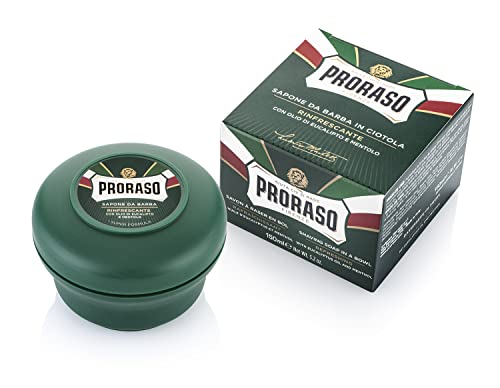
The menthol is the decision inside this one. You will feel the cooling on your face, and whether that is a pleasure or an irritation is personal. If you dislike a chill while shaving, pick a different scent from the roundup above rather than this one.
A cream to start with: Taylor of Old Bond Street, sandalwood
On the cream side, Taylor of Old Bond Street sells a sandalwood cream in a 5.3-ounce bowl. A cream sold in a bowl or a tube rather than a can is the kind you build with a brush and water, so it wants the same equipment as the soap above, just with less loading and more room to take only what you need.
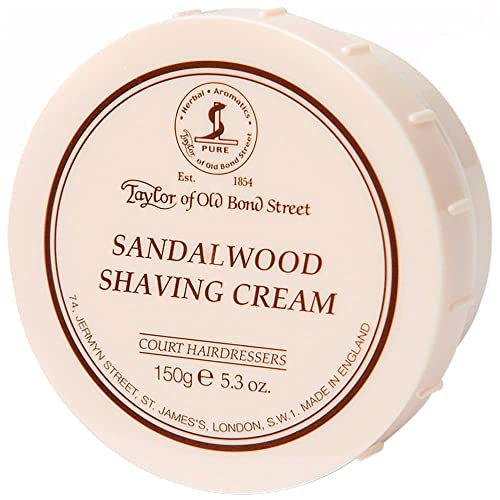
The sandalwood is the catch, and it is a real one: it is a distinct, sweet, old-fashioned scent that follows you out of the bathroom. If you are unsure about fragrance, read the next section before buying this one.
If fragrance is what your skin objects to
If your skin reacts, our first suspicion would be the fragrance or a preservative rather than the format. If you have narrowed the problem to scent, Van Der Hagen’s fragrance-free shave soap is the soap route with that variable removed, and it is the mildest place to start if you still want a puck.

Read the label rather than the category, in either format. “For sensitive skin” on a scented product is a marketing phrase; “fragrance-free” is a claim you can check.
Before you buy
- Buy one, not both. The two formats answer the same question, and owning both mostly means one dries out while you use the other.
- A brush is a separate purchase for soap and for any lathering cream — the shaving brush roundup starts with cheap synthetics, which is the right place to begin.
- A puck that will not lather is usually under-loaded or over-watered, not defective.
- If you want warm lather, cream warmers and hot lather machines heat a reservoir of liquid soap or cream rather than a solid puck, so the two formats do not plug into the same hardware.
- If you have run out mid-week, substitutes for shaving cream covers what you can use tonight without ruining your skin.
The short answer
If you will use a brush and want the product that costs least per shave, buy soap. If you want speed, a softer product, or you live with hard water, buy cream, and if you will not use a brush at all, buy a brushless cream. Pick the formula before the format: the format changes the work, the formula changes how your face feels afterwards.


Leave a Reply