Shaving coiled or tightly curly hair without bumps is a different problem from shaving straight hair, and it is mostly not a razor-brand problem. Hair that curls can leave the follicle at an angle, get cut below the surface of the skin, and grow back into it instead of out of it. What changes the outcome is how deep the blade cuts, which direction you travel, how many times you go over the same patch, and how much you pull the skin while you do it.
This guide is for you if your beard, jawline or neck hair is coarse and curly and you keep ending up with bumps, ingrown hairs or dark marks after shaving. It gives you the order to change things in, and it separates the two places where the standard advice contradicts itself, so you can decide for your own skin. If you are getting deep grooves, raised scars or painful lumps that keep coming back in the same spot, a shaving routine is not the fix and a dermatologist is.
Why curly hair comes back through the skin
The clinical name for razor bumps is pseudofolliculitis barbae. It is an inflammatory reaction to a hair that has re-entered the skin, not an infection and not acne.
The mechanism is worth knowing in order, because every change below follows from it. You shave, so the hair is cut and its tip is now a sharp, flat point rather than the natural tapered end. Because the hair is curly, that point does not reliably grow straight out of the pore. It either pierces the skin a short distance away, or it retracts below the surface and pierces the wall of its own follicle. Either way the body responds to it as a foreign object, and what you see afterwards is a firm, sometimes itchy bump.
Two things follow from that. It starts with the cut, so the hair has to sit at or below the skin surface for any of this to happen. And it is a curl problem rather than a hygiene problem, so scrubbing harder will not touch it.
Coarse, tightly curled hair is the main risk factor. Clinical references describe razor bumps as predominantly affecting men of African ancestry, citing a figure of roughly 45 to 80 percent, and attribute that to a higher prevalence of tightly curled, coarse hair rather than to skin colour itself. It is not exclusive to that group: anyone with coarse or curly hair is more likely to get ingrown hairs, and it is not limited to the face.
Under the jawline is the classic site, and the reason matters more than the fact. That is where the follicles point in several directions within a couple of centimetres, so a single stroke down the neck is with the grain for part of its length and against the grain for the rest.
This is also the condition that leaves marks. Repeated bouts cause post-inflammatory hyperpigmentation, and over time, scarring. That is why the aim is to interrupt the cycle rather than to shave carefully and treat whatever comes up.
If you are not sure whether you are looking at a razor bump, folliculitis or acne, what causes breakouts after shaving separates them. They need different responses, and only one of the three is solved by changing how you shave.
A closer shave is the wrong goal
Almost all shaving advice is written for straight hair, and it optimises for closeness. With curly hair that is backwards. The closer you cut, the more of the hair sits below the skin surface as it starts to grow, and the more likely it is to come back through the follicle wall instead of out of the pore. Closeness is what makes the bump possible in the first place.
The clinical guidance says this directly. Close shaving is listed as what sets the process off, and the recommendation is to leave about a millimetre of stubble. The NHS puts the same thing in plainer words: do not shave too close, and leaving at least 1mm can help.
At the sink that means aiming to take the hair down to skin level, not below it. The tell is what your face feels like five minutes later: smooth and then tight and stinging is a shave that went too deep. A shave that feels slightly less than perfectly smooth is the one that leaves you alone.
Blade count is where this gets oversold. Multi-blade cartridges are built to cut close in one stroke, the opposite of what you want here, so a single edge is a sensible default. Past that, the guidance is about closeness, direction and pass count rather than blade count: treat the number of blades as one way to control depth, not the answer.
Work out which way the hair grows, then stop pulling the skin tight
These two instructions look like a contradiction. They describe two different moments, so it is worth separating them.
To read the direction of growth, the American Academy of Dermatology suggests pulling the skin tightly while you look in a mirror. That is a diagnostic move: stretching the skin flattens it, so the hair lies flat and you can see which way the lie runs. The same guidance notes that if your hair grows in several directions you can train it with a soft toothbrush, daily.
To shave, do the opposite. Do not stretch the skin. One clinical reference suggests a trick that sounds strange until you try it: put your non-shaving hand behind your back. The reason is that your free hand wants to pull the skin taut, and taut skin lets the blade cut deeper than you intended.
Stretch to look, not to shave.
Map your own face in sections rather than as one direction: under the jaw, along the jaw, each side of the neck, and the hollow beside the Adam’s apple. Shave each section in its own direction. If a single stroke crosses a boundary where the hair changes direction, half of that stroke is against the grain, and that half is where the bumps will show up.
One pass, short strokes, soft hair
With the direction sorted, the rest is about reducing how much work the blade does on skin that is already prone to reacting.
- Softening the hair first. Shave at the end of a shower, or hold a warm, damp cloth over the area for a minute. The useful part is the reason: warm water makes the hairs swell, which makes them less likely to curve back into the skin. Let the lather sit for two to three minutes so a single pass is enough.
- Something that stays slippery. A moisturising shaving cream or gel rather than soap. It softens the hair and adds a layer between the blade and the top of your skin.
- Short strokes, rinsed often. Rinse the razor after every stroke, or at least frequently. A loaded blade drags.
- One pass. This is the habit that matters most and the one people abandon first. Going back over the same patch to catch what you missed is what produces the irritation, and on curly hair a second pass is a second chance to cut below the line you just set.
- A fresh blade, stored dry. Five to seven shaves is the usual interval for a disposable, and it should live somewhere dry afterwards. A blunt blade does not cut cleanly, it pulls.
- Cool water to finish. A cold rinse or a cool damp cloth calms the surface. It costs nothing.
How often to shave: where the advice disagrees
The advice you will find on this genuinely conflicts, which is why it is hard to settle.
The American Academy of Dermatology says to shave more often, daily or at least every two to three days, because hair that is cut regularly has less time to grow out and curve back. Other clinical guidance says to reduce shaving, for example to every other day. The NHS says not to shave every day if you can avoid it.
They are not being careless. They are solving different problems. The first is limiting how long a hair has to curl before it is cut again. The others are limiting how much trauma the skin takes. Which one applies to you depends on what your skin actually does:
- If your skin is calm after shaving and the bumps appear two or three days later as the hair grows back, the shave-more-often logic applies. Leaving it a week gives the hair more time to curl into the skin.
- If your skin is red, tight or nicked straight after shaving, the frequency advice applies instead. Give it a day.
- If it is both, shave every other day with a lighter single pass, and treat the skin in between.
The way to settle it is to change one thing at a time and watch what your skin does over the next few days.
What “mild” means on a razor
Razors get called mild or aggressive without anyone saying what those words refer to. Three things set how deep a razor can cut.
- Blade exposure: how far the cutting edge extends past the guard or safety bar in front of it.
- Blade gap: the distance between the edge and that bar. A wider gap lets the skin bulge up into it.
- How the head behaves under pressure. A pivoting cartridge head is designed to stay in contact and press as you push. A safety razor’s bar stops the edge at a fixed depth instead.
That is why a safety razor tends to be gentler here without being magically safe: the bar limits the cut, and the razor only takes what sits above it. The cost is technique. You hold the angle yourself, and it rewards a light hand and punishes a hurried one.
An adjustable razor puts exposure under your control instead of the manufacturer’s. That is genuinely useful here, because the right starting point for a bump-prone jaw is the mildest setting that still cuts, and the only way to find it is to start lower than you think you need and work up. The setting is only half of it, because blades differ at the same setting: choosing a shaving blade for sensitive skin is about that second half.
When to stop shaving this area and trim instead
It is worth being straight about the hierarchy, because the clinical guidance is. Stopping shaving is described as the safest and most definitive cure, and the inflammation can take several weeks to settle while the hair regrows. The first dermatology tip is the same: grow the hair out and you remove the cause. The NHS is blunt about it too, that the best way to prevent ingrown hairs is not shaving.
So the honest order is: stop shaving the area, or trim it short instead, or shave it carefully and accept that you have chosen the option with the most moving parts. If work or preference means you need a clean jawline, you are choosing the third one, and the price of that choice is the care described above.
The trimmer route is underrated for exactly this reason. The blade sits behind a guard, so it leaves a millimetre or two of hair rather than taking the hair below the surface of the skin. That below-surface cut is what starts the cycle. You lose the close shave and you keep the skin. For a lot of people with a curly beard that is the whole trade, and it is worth one honest attempt before spending money on shaving gear.
What to put on the area afterwards
The product advice splits the same way. The dermatology tip sheet suggests a soothing aftershave formulated to reduce the risk of razor bumps and irritation. Clinical references suggest a moisturiser, a glycolic-acid preparation for surface exfoliation, and warm compresses to soothe the area and lift crusts. The NHS points to an exfoliating product to release trapped hairs.
Exfoliation is doing a specific job here, and it is not deep cleaning. A hair that has curled back under the surface needs the dead skin over it loosened so it can grow out. That is why an acid toner or a mild scrub helps and why scrubbing harder does not.
If you want something aimed at razor bumps and ingrown hair specifically, rather than a general moisturiser, a post-shave toner is the closest fit.

Tend Skin Solution is a liquid you apply to the area after shaving, sold for razor bumps and ingrown hair. It is a treatment step, not the moisturiser you would reach for on a raw jaw, so use it on skin that is calm rather than angry. If the area is broken, weeping or infected, deal with that first: the NHS advice is to see a GP if it is very painful, hot or swollen.
Whichever product you use, the instruction that matters most is the plainest one in that NHS list: do not pick or squeeze. A bump opened by a fingernail is a bump that can become an infection.
The razor, if you are going to keep shaving
If the trimmer route is not for you and a cartridge keeps producing bumps, the sensible change is a single edge whose exposure you can start low.
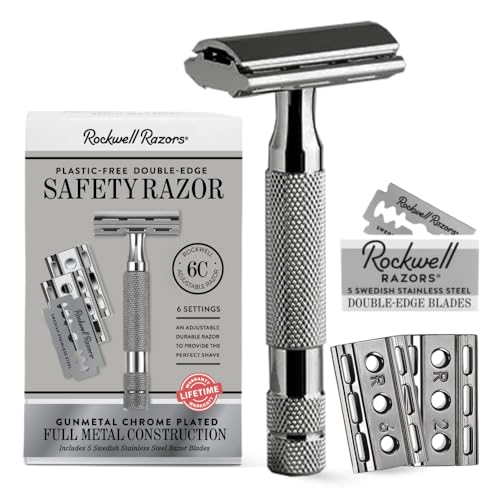
The Rockwell 6C is a safety razor with six settings, changed by swapping and flipping three plates. That adjustability is the useful part for this problem: you can begin at the mildest plate, shave for a week, and only move up if the shave is patchy, rather than guessing at a fixed razor and living with the result. What you give up is speed and simplicity. It is slower than a cartridge, you buy replacement blades once the five in the box run out, and there is a short learning curve that usually costs a few nicks. No plate setting prevents bumps either. The setting only controls how much of the hair the edge can reach; direction, one pass and a light hand still do the work.
If you want the wider set of options before deciding, safety razors for smooth shaving compares them by how much adjustability each one offers and what it asks of your technique.
When it is not a shaving problem
Razor bumps are common and usually manageable, and a few things that look like them are not.
- Signs of infection. See a GP if the area is very painful, hot or swollen, or if you have a high temperature or feel unwell. An infected follicle can go on to form an abscess.
- Scarring. Untreated razor bumps can leave deep grooves and raised scars, and keloid scarring is one of the listed complications. If the skin is already thickened or grooved, a different razor will not reverse it.
- Dark marks that persist. Post-inflammatory hyperpigmentation fades slowly and is not proof you are still doing something wrong, but it is the reason to break the cycle early.
- Anything that keeps returning in exactly the same place, bleeds or grows is a dermatologist’s call rather than a grooming decision.
If you have changed the direction, the number of passes and the blade, and you are still getting bumps, that is the point to see a board-certified dermatologist. There are treatments for this that a shaving routine cannot reach.
The short version
- Curly hair cut below the surface can grow back into the skin. That is the whole problem, and how close you cut is what sets it off.
- Aim for skin level, not below it. Leaving a millimetre of stubble is the recommendation, not a compromise.
- Read the direction of growth with the skin stretched in a mirror, then stop stretching it while you shave.
- One pass, short strokes, softened hair, a sharp blade and a cool rinse.
- Frequency depends on your skin: more often if the bumps appear days later, less often if the skin itself is angry.
- If you can stop shaving the area or trim it to a millimetre or two, that is what the clinical guidance actually prefers.
- And if the skin is already irritated rather than bumpy, calming shaving irritation covers what to do before your next attempt.


Leave a Reply