If your beard grows curly, wiry or in several directions at once, a beard straightener can pull it into a neater shape in a few minutes. This guide covers the whole routine: how to prep, which heat setting to use, how to work through coarse and curly growth without frying it, and how to choose a straightener that suits your beard rather than the one with the loudest listing.
It is written for someone doing this at home who wants a tidy, relaxed beard without a trip to the barber. If you already have a straightener and just want better results, jump straight to the step-by-step section. If you are still deciding whether to buy one at all, the short answer is that it helps most with longer, curly or coarse beards; on a short, fairly straight beard it will do little that a brush and a little balm will not.
What a beard straightener actually does
Beard hair holds its shape because of bonds inside the hair. Heat, helped by a little moisture from the air and from a product, loosens those bonds temporarily, so the hair accepts a new shape as it cools. That is why a straightener works, and also why the effect is temporary: once your beard gets wet again, the curl tends to come back. You are reshaping the beard for the day, not changing how it grows.
There are two common formats. A heated brush has heated bristles or a heated plate behind the bristles; you brush the beard and the heat does the work as you go. A straightening comb looks like a comb with heated teeth; it gives you more control at the root and around the mustache but takes more passes. A third option is a hot-air brush or a blow dryer with a comb, which combines warm air and tension; it is gentler and slower, and better if your beard is only mildly wavy. None of them will beat how your beard grows forever, and none is a substitute for an actual trim if the shape itself is the problem; that is a job for a trimmer, and our guide to trimming a beard covers that.
Before you start
- Start dry. A straightener goes on dry, detangled hair. Using it on a wet beard risks scalding steam and gives an uneven result.
- Detangle first. Work through knots with a wide-tooth comb before any heat, so the tool does not snag. Our guide to choosing a comb explains the tooth spacing that suits longer growth.
- Add a little product. A few drops of a light beard oil spread through the beard softens it and is the usual way to prepare hair for heat. See our guide to beard oils if you are not sure what to look for.
- Give yourself a clean start. A beard that has just been washed and conditioned behaves better under heat than one carrying a day of product and dust.
How to straighten your beard, step by step
Step 1: dry, detangle, and load a small amount of oil
Pat the beard dry if you have just washed it, comb it straight, then work a small amount of beard oil from root to tip. Use less than you think: a heavy coating makes the hair limp and can leave the tool greasy. If you washed and want the full routine, our guide to the right beard wash covers the wash-and-condition stage that comes before this.
Step 2: heat up, then start on a low setting
Let the tool come to temperature before it touches your beard, and start on the lowest setting. Fine or thin beard hair straightens quickly and does not need much heat; thick, coarse or tightly curled hair usually needs a step or two higher. The mistake is to begin hot because the beard is stubborn. You can always add heat on a second pass, but you cannot undo a scorched patch.
Step 3: work in slow, even passes, root to tip
Take small sections and draw the tool slowly from near the skin down to the ends, keeping it moving the whole time. Do not hold it still in one spot, and do not press it against your face; let the heat and the bristles or teeth do the work. Follow the direction the hair already lies rather than fighting it, and give each section one or two passes before moving on.
Step 4: deal with the stubborn areas
The chin and the mustache usually need the most attention, and the sides and neckline the least. For a curl that springs back, add a little more oil and pass again rather than raising the temperature straight away. If a section still will not sit, it is usually because you are trying to straighten too much hair at once. Take a thinner section.
Step 5: shape, set, and let it cool
While the beard is still warm, shape it with your fingers or a comb into the style you want, because it will hold the shape it cools in. Then leave it alone to cool for a minute before you judge it. A small amount of beard balm worked through at the end adds a little hold and weight, so the straightened beard stays put through the day.
If your beard is curly or coarse
Tightly curled and coarse beards need more patience and less heat than you would expect. Straighten in two lighter passes rather than one heavy one, and accept a slightly relaxed, natural finish instead of perfectly straight hair. Chasing a flat, straight look on a very curly beard usually means using enough heat to damage it. Keeping the beard conditioned and detangled also does a lot of the work on its own.
How to avoid heat damage and burns
- Never use the tool on a wet beard; wait until it is dry.
- Keep it moving, and never rest it against the skin, because heated teeth and plates burn quickly.
- Use the lowest setting that gets the job done, and step up only if you need to.
- Do not straighten every day if you can help it; give the beard a break between sessions.
- Unplug or switch off and let the tool cool fully before you put it away.
If your beard starts to feel dry, brittle or split at the ends, that is a sign you are using too much heat or too little conditioning. Back off the temperature, add oil, and let it recover. A straightener is a styling tool, not a treatment, and daily use will take a toll that no product fully hides.
If you would rather not use heat
A blow dryer on a low setting with a round or comb attachment, used on a damp beard, can relax a mildly wavy beard with far less direct heat. Balm and a boar-bristle brush, used consistently, train a beard into a tidier shape over time. Both are slower than a straightener, but both are worth trying first if your beard is only lightly unruly. Our guide to the beard grooming tools explains where each of these fits.
Which beard straightener to buy
Most beard straighteners work the same way, so the differences that matter are the format (brush or comb), whether it runs on a cord or a battery, how the temperature is controlled, and whether the teeth or bristles are designed to keep the hot surface off your skin. Below are four that cover the common cases; pick the one that matches how you use it rather than the one with the most settings.
A heated brush for coarse and curly beards
The Wild Willies Beard Straightener Brush & Hot Comb is a heated brush aimed at coarse and curly beards, with tourmaline ceramic heating, three temperature settings and ionic technology. Three settings cover the usual range for beard hair without much guesswork, which suits someone straightening at the mirror at home. The trade-off is that the range is limited: a tool with more settings lets you fine-tune more, and this one leaves less room to adjust than the brushes below.

A cordless option for travel
The REHOYO cordless heated beard brush runs on a rechargeable battery, so there is no cord and no outlet to find. It keeps three heat settings, an anti-scald design and ionic technology, and it comes with a small case. That makes it the one to take on a trip or to use somewhere without a socket. The limit is heat: with a rechargeable tool you trade the highest temperatures and the longest run times for the freedom of no cord, so very coarse beards may want more.

A simple brush to try first
If you are not sure a straightener is for you, the FEBOTE heated ionic straightening brush keeps the essentials (five temperature settings, an anti-scald design and a travel bag) in a straightforward brush. It gives you more heat settings than the two above, which helps you find the setting that suits your beard. It will not match the build quality of a more expensive tool, and like most inexpensive brushes it is best treated as a way to learn the technique before you commit to more.

A kit if you are starting from nothing
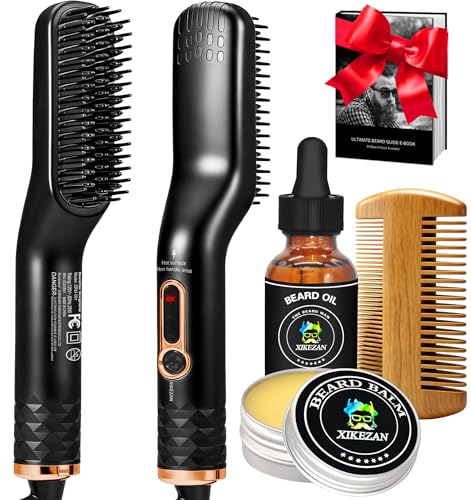
The XIKEZAN beard straightening kit bundles the tool with the rest of the routine (a small bottle of beard oil, a balm, a comb and an e-book guide) and runs on dual voltage with an automatic shut-off. If you are setting up a beard routine from scratch, buying the oil and balm you need anyway in the same box is simpler than sourcing each piece separately. You get less control over exactly which oil and balm you end up with, so someone who already has favourites is better served by a standalone brush.
The short version
Straighten a beard on dry, oiled, detangled hair, on the lowest setting that works, with slow passes and no pressure, and set the shape while it is still warm. Keep the heat moderate and use a straightener only as often as you need to, and it will tidy your beard without making it brittle. If your beard has been breaking or your skin is irritated, stop for a while and see a barber or dermatologist before you keep going.


Leave a Reply