A back shaver is not a razor you happen to hold behind you. It is a tool built around one problem: the surface you are working on is out of sight. You cannot watch the angle, and your hand cannot easily follow the curve, so the device has to stand in for your eye and your wrist. Which one is best depends on which of those two it can actually solve for you.
This guide is for a man who wants the hair off his back at home, alone, without asking anyone for help. It covers the three mechanisms and who each one suits. It does not teach the method: how to shave your back covers direction, mapping the hair by feel and aftercare, and it is the better use of ten minutes before you buy anything.
One thing this page will not do is name a winner in the abstract. Two of these are electric trimmers that leave stubble. One is a blade that leaves a smooth back and cannot be aimed. That is a difference in the result, not in taste, and no ranking hides it.
Reach, angle and sight are three different problems
Every difficulty with shaving your own back comes from one of three things. They feel like one problem and they are not.
- Reach is distance: how far your hand has to travel to the middle of your back.
- Angle is keeping the cutting edge flat against skin. On your face you do this by watching and correcting. Behind you, there is nothing to correct against.
- Sight is the one no feature solves. No handle length fixes it.
A long handle solves reach and makes angle harder at the same time, because your wrist is now steering a head eighteen inches away through a shoulder that is not designed for it. An articulated head attacks angle directly. That the most expensive device here has a hinge that locks a shaving angle tells you the manufacturer knows which part is difficult. None of the three solves sight, which is why direction has to be decided by touch before the blade or foil touches skin, and why the technique page earns its place.
Which of the three problems dominates also depends on where you are working. The middle and lower back is mostly a reach problem. The shoulders are mostly an angle problem, because the arm cannot comfortably cross behind the shoulder blade. The chest is neither: you can see it and reach it, so any of these devices works there, and the choice becomes coverage and cleanup rather than reach.
The three mechanisms at a glance
Read the left column as what you will be holding. Read the right column as the consequence you live with after the box is open.
| Type | The pick, and what it decides for you |
|---|---|
| Blade, long handle | baKblade 2.0 PLUS: closest to a shave, angle set by your hand |
| Electric, fixed head | MANGROOMER 101-6: stubble, not a shave |
| Electric, hinged head | Platinum Pro Gen 8.0: the head holds the angle, more parts to clean |
The rest of this page is the detail behind each row, in the order of what each one costs you.
A blade on an 18-inch handle: baKblade 2.0 PLUS
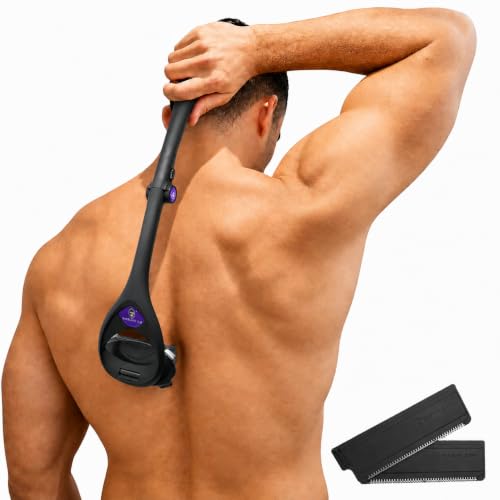
The baKblade 2.0 is a cartridge razor on a folding handle that extends to 18 inches. The DryGlide cartridges are titanium-coated, the tool takes no batteries, and you can shave wet or dry. The PLUS package adds an exfoliating brush, a suction-cup shower mount, a cleaning brush and a spare three-pack of blades.
Who it suits. The reader who wants an actual shave, smooth rather than stubble, and is willing to work by feel. It is also the only one of the three the maker describes as usable wet or dry, so it is the only one that fits a shave in the shower.
What you give up. The angle. The handle is rigid and the head does not articulate, so the blade sits at whatever angle your shoulder and wrist produce, on skin you cannot see. A blade that is not flat will cut, and that is the risk you are accepting. It is the reason this is the wrong first device for someone who already knows he is clumsy behind his back. Cartridges are also a habit rather than a purchase: they are sold separately, they are shared with the 3.0, and the cost does not stop at checkout.
The brand’s own copy promises a good deal more than that. Judge it on the mechanism instead: a fixed blade on a long arm is the closest thing to a shave in this comparison, and the least forgiving.
An electric foil trimmer on an adjustable arm: MANGROOMER 101-6
The 101-6 is a single foil head with a 1.5-inch blade on a handle that extends and locks at any length. The handle opens to 135 degrees and folds flat for storage, it runs on alkaline batteries, it needs no water or shaving cream, and it is the least expensive of the three.
The manufacturer calls the blades self-sharpening and hypo-allergenic, and says the design avoids the ingrown hairs that manual back razors can cause. Take those as the manufacturer’s claims. What the specifications do tell you is a small foil head, one blade, and a handle you can set to your own reach, which is the part that matters when you are working blind.
Who it suits. Coarse or dense hair, a first pass before a blade, and anyone who would rather not put steel on his back. It is also the sensible pick if you want the lowest price and no cartridges to keep buying.
What you give up. The shave. A 1.5-inch foil head over a whole back is a lot of passes, and the finish is stubble. The head does not articulate either: you change the angle by changing where you lock the handle. Battery power means you buy batteries rather than charge a battery. Its marketplace record is a long, mixed one: 3.7 stars across thousands of ratings.

An electric with an articulated head: MANGROOMER Platinum Pro Gen 8.0
The Platinum Pro ships with three interchangeable heads: a 2.7-inch ultra-wide groomer blade for large areas, a 1.8-inch blade for detail, and a foil head for maintenance and short hair. Each sits on a shock-absorber flex neck, the handle extends and locks, and a power hinge lets you lock the head at a chosen angle instead of holding it there. It is rechargeable with a charge indicator and it comes with a travel case.
Who it suits. The reader who will do this every week or two and wants the angle handled for him. The hinge and the flex necks are the only features in this comparison that address the actual difficulty of working behind your back, and that is what the money buys.
What you give up. Money and simplicity. It is the most expensive of the three by a distance, and three heads mean three parts to swap and clean. The manufacturer says the blades last six months or longer and that you avoid razor refills; that is a claim, and it is the claim the price rests on.
For a reader doing this once a month, it is a lot of device. For a reader doing it fortnightly for years, the angle lock is the feature that decides whether it stays in the rotation.

What each one costs you after you buy it
One of these needs cartridges; two need no refills. That is the dividing line for running cost. A blade setup’s cost scales with how often you shave, and buying replacement cartridges is normal ownership rather than a fault. An electric carries its cost up front and then a slower one: batteries in the 101-6, and a new head on either when a foil stops cutting and starts pulling. Compare a year of each rather than the two numbers at checkout.
The second after-sale cost is cleaning, and it is easy to underestimate. Hair and dead skin pack around a blade you cannot see, on a surface you cannot inspect. A head that is never cleared cuts worse and lasts less time, which is the whole subject of how to extend the lifespan of a shaver head.
Cleaning a tool you cannot see
You will never see the head look bad, so clean on a schedule rather than on evidence.
- Rinse or brush the head after every use, and let it dry open rather than folded shut.
- On the three-head device, clear each head in turn. The one you used last is the one that clogs.
- Replace a foil or blade when it pulls, snags, or needs more passes for the same result. Not on a calendar.
That last rule is worth more than the others. A dull foil does not announce itself; it just starts taking two passes where one used to do, and you blame your technique.
Aftercare is the half the device cannot do
The device decides how close you get. It does not decide whether your skin objects. Breakouts and bumps after shaving have their own causes and their own handling, in what causes breakouts after shaving. A back is a bad place for an ingrown hair, because you cannot see it forming, so preventing and treating ingrown hairs is worth reading before your first session rather than after.
If you exfoliate, exfoliating without making things worse is the version that helps. And if what is holding you back is the old idea that shaving changes the hair that grows back, that one has a clear answer.
None of this changes which device to buy. All of it changes whether you are still using it in three months.
Which one to buy
- You want a smooth back and will work by feel: the baKblade 2.0 PLUS. Accept that a fixed blade is unforgiving and that cartridges are a running cost.
- You want the cheapest way to keep the hair down and do not need smooth: the MANGROOMER 101-6. Stubble, batteries, and more passes than you expect.
- You will do this regularly and want the angle handled for you: the Platinum Pro Gen 8.0. No cartridges to buy, three heads to clean, and the angle decided by the head.
If your back hair is long, none of these is step one. Trimming first is not a formality: a shaver or foil clogs on long hair and pulls. Body hair trimmers covers the devices for that first pass, including the ones that work on a chest and shoulders. Trim, then choose from the three above for the finish you actually want.
Before you buy
- Measure your own reach instead of trusting a handle figure: raise one arm, and see where your hand sits when you reach across your back. A handle that is longer than you need is a lever you fight.
- Check that the replacement blade or foil is sold where you shop. A device with no available replacement becomes waste, and that applies to both the blade and the electric options.
- Skip any bundle with parts you will not clean. That is an easy way for these to end up in a drawer.
Then check the current configuration and availability on the device you picked, and give the technique page ten minutes before the first attempt.


Leave a Reply