Beard scissors are for detail, not for bulk. If you want an inch taken off the whole beard, a trimmer does it faster and more evenly. If you want the mustache line cleaned up, a stray patch leveled, split ends removed or a cheek line kept sharp between proper trims, scissors cut closer and with more control than any trimmer head will.
This guide is for you if you trim your own beard and want one pair of scissors that fits your hand and your beard. It covers what actually changes between pairs, then three sets worth buying at three different prices: a complete budget kit, a 5.5-inch pair that suits most men, and the one option a left-hander can use properly. Skip it if your beard is shorter than a day’s growth, if you use a trimmer with a guard for everything, or if you are shopping for haircutting shears for the hair on your head. That is a different tool, and it is covered further down.
The three picks, at a glance
One row per pick, with the decision each one is built for. The offer cards further down carry the current price and availability; the comparison here is about what changes between them.
| Pick | What decides it for you |
|---|---|
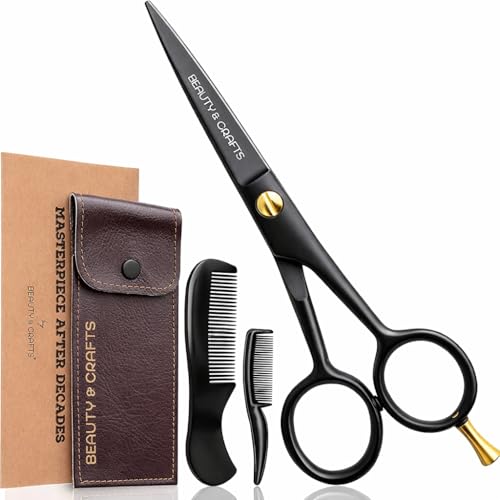
| Beauty & Crafts 5-inch set | Budget kit: two combs and a pouch. The cheapest of the three. No finger rest and no tension screw, with an ordinary build you may end up replacing. |
| Ontaki 5.5-inch | Blade the maker describes as convex, with a finger rest and an adjustable tension screw. Right-handed only, and priced in the middle. |
| Left-hand 5.5-inch | Mirrored in high-carbon stainless steel. The priciest of the three, with fewer finishes and bundles around it. |
What actually changes between pairs
Five things decide whether a pair works for you, and only one of them is the steel.
Blade length
Blade length sets how much control you have at the tip. Facial-hair scissors are made between roughly four and a half and five and a half inches, and that range is short for a reason: the closer your fingers sit to the cut, the more accurately you can follow a curve. A six-inch barber shear is a haircutting tool. The extra reach is useful across a head of hair and works against you at the corner of a mustache.
Straight or curved
A straight blade cuts a line you can see and is the one to learn on. A curved blade is shaped to follow the hollow under the nose and the curve of a jawline without the tip digging in. Curved blades also tend to have rounded tips, which matters if you are cutting near an earlobe or a nostril. If you are buying one pair, buy straight and learn to angle it; add a curved pair later only if you keep missing the same spot.
The edge, and what the steel labels mean
Listings advertise German steel and Japanese steel. Those words describe where the steel or the blade-making tradition comes from. They are not a grade, and the listings rarely publish a hardness figure you could compare across brands, so treat the label as background rather than a reason to pay more. What you can compare is how the edge is made. A convex edge is ground on a wheel and cuts smoothly; it is not designed to be resharpened at home. A bevel edge has a flat, visible cutting face. Either is fine for a beard; both are ruined by cutting paper, thread or wire.
The pivot, the tension screw and the finger rest
A screw through the pivot lets you take up slack as the blades wear in. If your scissors start folding hair instead of cutting it, that screw is usually the reason rather than the steel, and a quarter turn is the fix. A finger rest is the small hook your ring finger sits against; it steadies the pair during longer shaping work. Neither feature appears on the cheapest sets, and both are worth having if you trim more than once a week.
Handedness
Scissors are assembled as a handed pair. In a right-handed pair the thumb blade crosses to the side your thumb sits on, so closing your hand drives the two cutting edges past each other. A left-hander holding that same pair pushes the edges apart instead, and hair bends between the blades rather than being cut. This is not a matter of practice or preference, which is why the third pick below exists.
The comb you will use with them
You cannot cut a beard evenly without combing it straight first, and a beard comb is a separate decision from the scissors: tooth spacing and material matter more than price. The beard and mustache comb guide covers that choice; two of the picks below include a comb so you can start with one order.
The budget set: a full kit for very little
The Beauty & Crafts 5-inch set is the cheapest way to find out whether you like trimming with scissors at all. Five inches, black, sold as German stainless steel, and it arrives with two mustache combs and a pouch. For a reader starting from nothing, that one order covers the tool and the comb that goes with it.
What you give up is build quality. At this price the pair is mass-market and replaceable rather than repairable: the build is ordinary, and you should expect to replace it long before your technique stops improving. That is a fair trade if you trim occasionally. If you shape your beard twice a week and want to keep one pair for years, it is the wrong place to save.
The pair most readers should buy: Ontaki 5.5-inch
Half an inch longer than the budget set, which matters less than the two details in the listing: an ergonomic finger rest and an adjustable tension screw. Those are the features that separate a pair you can use for five minutes from one you can use for fifteen without your hand cramping. They are the reason this is the pair to start with.
The maker describes the blade as hand-forged Japanese steel with a convex edge ground for barber cutting. Take that as the vendor’s description rather than a measured claim. What it means in practice: the edge is built to cut hair smoothly and to be maintained rather than resharpened, so keep it dry, do not drop it, and do not cut anything but hair. This variant is right-handed only.

If you are left-handed: a mirrored 5.5-inch pair
Left-handers are usually told to get used to a right-handed pair, and mechanically that does not work: the blades are mirrored, so the cutting edges separate instead of crossing. The left-handed version of this size is mirrored at the factory, 5.5 inches, in high-carbon stainless steel, so it cuts the way a right-handed pair cuts for everyone else.
What you give up is choice and a little money. It costs more than the Ontaki, and there are fewer finishes and bundle options around it. If you are left-handed and trim regularly, it is still the pair to buy, because the alternative is fighting the tool on every cut and blaming your technique for a result the scissors caused.

How to trim with them
Comb the beard in the direction it grows, then comb it back against the grain so the hairs stand up and you can see the real length. Cut a few millimeters at a time, working from the longer side towards the shape you want, and comb between passes: scissors remove length you cannot put back. Leave the mustache until last, when your hand has warmed up. The full step-by-step beard trim covers the order of work and the neckline, which is the part most people get wrong.
Care
Wipe the blades after each use, keep the pair dry, and put a drop of light oil on the pivot every few weeks. Store them closed, and not loose in a drawer where the tips can knock against something harder than they are. If the blades start folding hair, tighten the tension screw a quarter turn before you assume the scissors are finished. If you also use a trimmer, its blades need a different routine: cleaning a beard trimmer properly is a separate job with its own failure modes.
When scissors are the wrong tool
If your beard is longer than about an inch and you want it shorter all over, use a trimmer with a guard. Scissors are for keeping a shape, not for creating one out of a full beard, and trying to do it with scissors is how beards end up lopsided. The beard trimmer picks cover that job by beard length and budget.
If you are still deciding which trimmer suits you, rather than which is objectively best, the trimmer decision guide is the place to start: it asks what your beard actually needs instead of ranking models.
If you also cut your own hair
Facial-hair scissors are not haircutting shears. The blades are shorter, the pivot is lighter and the edge geometry is set up for small amounts of hair close to the skin. If you cut your own hair, or thin it, you want barber scissors built for haircutting and thinning instead. Buying one pair to do both jobs gets you a pair that is mediocre at each.
Before you buy
- Check the length in the listing title, not the photos. Several of these brands sell 5-inch and 5.5-inch versions from the same page.
- Check handedness in the title too. Left-handed variants are usually a separate listing, sometimes the same product name with one word changed.
- Check what is included. A comb and a pouch are worth having if you own neither; they are padding if you already have both.
- Check whether the pair has a tension screw. If it does, expect to adjust it when the scissors arrive: a pair that folds hair on the first cut is usually set loose, not defective.
- Decide whether you want a repairable pair or a replaceable one. That single question explains most of the price difference between these three.
The cards above show the current price and availability for each pick. Prices and variants move on all three, so check the listing before you order rather than trusting a figure you read elsewhere.


Leave a Reply