Your back is the one place where shaving is decided by reach rather than by technique. Everything written about shaving assumes you can see the blade and feel the angle, and behind you neither is available. That single fact changes which tool works, which direction counts as with the grain, how much pressure you are using without meaning to, and what you can realistically check afterwards.
This is for you if you have back or chest hair you want gone and your own hands are the only ones available. It is written for a first attempt, and for the reader whose first attempt left him itchy between the shoulder blades. Skip it if what you want is permanent hair reduction, because nothing below achieves that: laser and electrolysis are a different decision with a different cost, and they appear in the list further down only so you can rule them in or out. Skip it too if you currently have painful bumps on your back, because this routine will make them worse and the article you want is the one on preventing razor burn and irritation.
The question everyone asks first
Shaving does not make hair grow back thicker, and it does not make it grow back faster. Stubble feels coarser because a cut hair ends in a blunt edge where an uncut hair tapers, and your hand reads that bluntness as thickness. If that belief is the only thing standing between you and starting, it is worth reading why shaving doesn’t thicken hair before you spend anything.
Why your back is the hard case
On your face, two things keep the shave honest. You can see the blade angle in a mirror, and your wrist can feel the pressure it is applying. Both are gone behind you. You are working at the end of an arm, over a curved surface, at an angle you are guessing at, and the patches you can reach comfortably are not the patches that need attention.
That is not a minor inconvenience. The things that usually go wrong when someone shaves are an edge held too steep, too much pressure, or a pass in the wrong direction, and all three are exactly what you cannot monitor back there. So the answer is not to try harder with an ordinary razor. It is to take as much of the guesswork out of the tool as you can before you start.
If you already shave your head, you know this feeling. It is the other area people shave without really watching the blade, and the habits that make it work, a fixed order of passes and a light hand you have learned to trust instead of see, transfer directly to your back. If you have not done it, shaving your head is a decent rehearsal, because at least you can inspect the result in a mirror afterwards.
Decide the method before you buy anything
Shaving is one of several ways to deal with back hair, and on a back it is not automatically the right one. It cuts the hair at the surface and the result does not last long, which is why the general guidance is that you may need to shave every day or every few days. Over an area you can neither see nor reach easily, that is a demanding schedule to keep up.
Here is the honest comparison, in the terms that actually matter for a back:
- Trimming leaves stubble rather than a smooth surface, and it interrupts the cycle of hairs retracting under the skin. If you want less hair rather than no hair, this is the lower-effort, lower-irritation answer.
- Shaving gives you the smooth result, at the cost of a blade on skin you cannot watch and regrowth you will feel within days.
- Depilatory creams dissolve the hair and typically last longer than shaving, but you would be applying a chemical across a large area you cannot see. That is a poor combination for a first attempt and a worse one if your skin is reactive.
- Waxing pulls hair out at the root and results last a few weeks or more, but it hurts, and on a back it is a two-person job or a salon appointment.
- Laser hair removal, performed by a board-certified dermatologist, takes about six treatments to destroy the follicle; at-home devices take considerably longer to show anything. Electrolysis damages one follicle at a time, which may not be practical across a whole back.
If you read that list and thought “less hair is fine, actually”, stop here and go to how to choose a body trimmer. Choosing between trimmers is a real decision with its own trade-offs, and it is not this page’s job to repeat it.
What actually reaches your back
This is where the tool stops being a matter of preference. An ordinary razor in an ordinary hand cannot get to the middle of your back, and the home-made workaround, lashing a razor to something long, fails for a specific reason. The head stays rigid relative to the handle, so over a curve the blade digs in at the shoulder blades and at the small of your back while skating over the hollow between them. The pressure concentrates precisely where the surface turns away from you.
Devices built for this solve it by putting the cutting head on a handle long enough to reach and flexible enough to follow the curve. Three shapes are worth knowing, and they suit different situations.
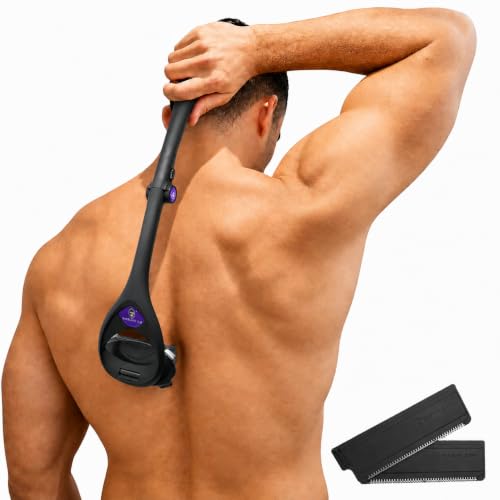
The first is a razor head on the end of a handle, and it is for you if you want the closest result you can get on your own and you are willing to lather and put a blade on your skin. The one below shaves wet or dry, comes with extra blades and has an ergonomic handle. The trade is plain: you still have to lather an area you cannot see, and a blade on blindly shaved skin is where irritation starts. The direction and pressure instructions below matter more with this tool, not less.
The second is an electric built for the job. This one is for the reader who does not want a blade on a surface he cannot watch, and who wants it finished in a couple of minutes without lather. It will not give you the same smoothness as a blade, and it is worth knowing that before you buy rather than after. What it does buy you is a much smaller chance of the thing that ruins a first attempt: an edge at the wrong angle on skin you cannot feel.

The third is only for someone who has already decided this is a monthly routine rather than a one-off. It costs considerably more than the other two and it is not the place to start. What the money goes to is reach and flexibility, which the listing describes as three shock-absorbing flex heads, a power hinge and an extreme reach handle. That is a direct answer to the rigid-handle problem described above.

Map the direction with your hand, not your eyes
Nearly every shaving instruction tells you to shave in the direction the hair grows, and dermatologists do treat that as an important step in preventing razor bumps and burns. On a back it is harder than it sounds, because the hair does not all grow the same way.
Run your hand flat over your back before you start. You will feel the direction change: often outward from the spine, downward from the shoulders, and different again across the shoulder blades. That is not you doing it wrong; it is where the hair changes direction. It is also why the clinical guidance on razor bumps, which was written mainly about beard hair, concedes that a single direction of growth may simply not be available on coarse or curly hair, because the hair grows in many directions at once.
So do this instead. Map the main directions by feel while your back is dry, pick the direction you will use across the middle, and accept that the edges will be approximate. Then keep the number of passes low. One pass in a roughly right direction is far kinder than three passes spent chasing a patch you cannot verify.
The shave itself
Wet the area properly first. Warm water softens hair, and shaving straight after a shower is the easiest version of this, because the skin is already warm and moist and free of the excess oil and dead skin cells that clog a blade.
Then apply cream or gel generously. This is not a formality. Foam or gel forms an anti-friction layer that lets the razor glide instead of drag, and that layer is doing more work on a back than on a face, because you cannot make up for a dragging blade with a delicate touch you cannot feel. If your skin is dry or reactive, look for a cream labelled for sensitive skin.
Keep the skin still rather than tight. This runs against most of what you will read elsewhere, so it is worth being exact: pulling skin taut lets the hair be clipped below the surface, where it can re-penetrate as it regrows and cause further irritation. On your face that may be a trade you make deliberately, in a place you can watch. On your back, where you cannot inspect the result for a day or two, it is a bad trade. Flatten the surface if you need to; do not stretch it hard.
Rinse the blade after every pass, not every few. Change the blade, or bin the disposable, after five to seven shaves. The usual warning that a blade has dulled is a tug you can feel, and that is the one signal you will not reliably get behind you, so replace it on a schedule instead.
Store the razor somewhere dry so it dries completely between shaves. A razor left damp in a shower gives bacteria somewhere to grow, and you are the one pressing it into your skin.
How close should it actually be?
There is a real temptation, on the area you can inspect least, to chase the smoothest possible result. That instinct is backwards. Closeness is not free: the same manoeuvres that get you closer are the ones that put you at risk of ingrown hairs, and the bill is paid in skin. On a back, where regrowth is quick and you cannot see the damage developing, the marginal gain from a third pass is small and the downside is not. What a close shave actually costs is worth reading once if you are the sort of person who keeps going until it feels smooth.
What goes wrong: folliculitis, not just razor burn
Three things happen to shaved skin and they get confused with each other, which matters because the responses differ.
Razor burn is surface irritation, and it settles. An ingrown hair is a strand that grows back into the skin instead of out, and it shows up as a raised, sometimes discoloured bump that can take one to two weeks to clear. You are more likely to get them if you shave often and if your hair is thick, coarse or curly, and the back is one of the places they turn up. Prevention is the routine above, done properly; treatment is preventing and treating ingrown hairs, and it is not picking at them.
Folliculitis is the one worth knowing by name, because the upper back is one of the places it commonly appears. It is inflammation or infection of the follicle, it looks like small red or pus-filled bumps, and it is associated with shaving often and with sweating heavily without washing afterwards. There is also a variant that favours the upper chest and back, is aggravated by sweat, and often improves with washing the area daily using an antidandruff shampoo, which is not a conclusion you would reach on your own.
If the bumps look like acne, they may not be. Breakouts, razor bumps and folliculitis are three different problems, and scrubbing a folliculitis outbreak as though it were acne makes it worse. If the problem is soreness rather than bumps, follow the routine for preventing razor burn instead.
Aftercare for an area you cannot see
The awkward part of aftercare on a back is the inspecting, so you end up treating by feel and by what your shirt tells you. Keep it simple: rinse off the residue, dry the area properly rather than half-drying it with a towel, and then leave it alone.
Exfoliation helps release hairs trapped under the surface, but it is easy to overdo on a back, because the redness you are causing is the one thing you cannot check. Gentle and occasional beats thorough. How to exfoliate without making it worse covers the technique.
Do not pick, scratch or pop anything you find back there. That is the easiest way for a small bump to become an infected one, and it is harder to leave alone when you cannot see how small it currently is.
When to stop and see someone
Most of what happens after shaving settles on its own. Some of it does not, and the warning signs are worth knowing precisely because you cannot see your own back.
See a healthcare provider if folliculitis spreads beyond the area you shaved, if spots are firm or painful, if anything is draining fluid, or if you have fever, chills or fatigue along with it. The same goes for an ingrown hair that will not settle or that looks infected. None of those are situations to keep shaving through.
One more thing, and it is the one the internet handles worst. If you are a woman and coarse, dark hair has appeared unexpectedly and thickly across your back, chest or abdomen, that pattern has a name, hirsutism, and it is usually caused by high levels of male hormones. That is a conversation for a doctor rather than a reason to buy a bigger razor. Shaving will not address a hormonal change, and treating it as a grooming problem only delays the thing that would help.
The chest, briefly
Chest hair is the easier version of the same job, with two differences worth using. You can mostly see it, so check which way it runs in a mirror before you start rather than assuming it grows downward, and let that decide your pass direction. And the bony ground over the collarbones and sternum is where a heavy hand is most likely to leave a mark, so that is the part to do last and lightest.
If you want the chest smooth and the back merely reduced, do not force one device to do both. Trim the back, shave the chest, and accept that two jobs may want two tools.
The short version
Decide first whether you want less hair or no hair, because that single answer chooses trim or shave and nothing else matters until it is settled. If you are shaving, use a tool with a handle long enough to reach and a head flexible enough to follow the curve, because your wrist cannot do that job blind. Map the direction of growth by hand while dry, keep the skin still rather than stretched, rinse every pass, and change the blade on a schedule rather than on a feeling. Expect the upper back to be the sensitive part, treat folliculitis as a known possibility rather than a mystery rash, and leave anything you find there alone.
None of that is complicated. It is simply a set of instructions written for someone who cannot see what he is doing, which is the situation you are actually in.


Leave a Reply